
Small Living Room TV Ideas That Save Real Space
Small living room TV ideas that save real space start with the wall, not the stand: mount the TV, keep the console slim and low, and hide the cables, and the screen stops eating floor space. In a small room the TV is usually the biggest dark rectangle on the wall, and a deep stand underneath it takes the floor the sofa needs. Move the screen onto the wall and the room gets its walkway back — and the TV looks better, too, because it sits at eye level instead of looming over a bulky cabinet.
The ideas below work in that order: place the TV first, then choose the furniture under it, then deal with the cables and the sound. Measure the viewing distance before you buy anything, and keep the walkway in front of the sofa clear.
Last updated 15 Nov 2026. Refresh in 3–6 months: re-check the mount and console weight ratings, and re-route the cables after any furniture move.

Key Takeaways
- Wall-mount the TV first — it frees the floor completely and lets you choose a console that fits the room, not the screen.
- Keep the console slim and low: a floating or low bench under the TV, a little wider than the screen, with closed doors for the boxes and remotes.
- Hide the cables with a paintable cord cover or by routing them behind the console — dangling cables make a small room look messy faster than almost anything else.
- Right-size the screen to the distance you sit from it, and use a soundbar instead of bulky speakers.
Wall-mount the TV
A wall-mounted TV is the single biggest space saver in a small living room, because it takes the TV and its stand off the floor entirely. The screen hangs at seated eye level, the floor beneath it stays open, and cleaning underneath takes seconds instead of a furniture move. The photo shows exactly that: a wall-mounted TV on a white wall in a small living room with a grey sectional sofa and open floor space beneath it — no stand at all.
Mount the centre of the screen at seated eye level and keep the sofa facing it straight on, not at an angle. If you rent and cannot drill, a freestanding TV mount on a pole gives you the same wall-mounted look with no holes — check the weight limit and the screen size it supports before you buy.

Slim floating media console
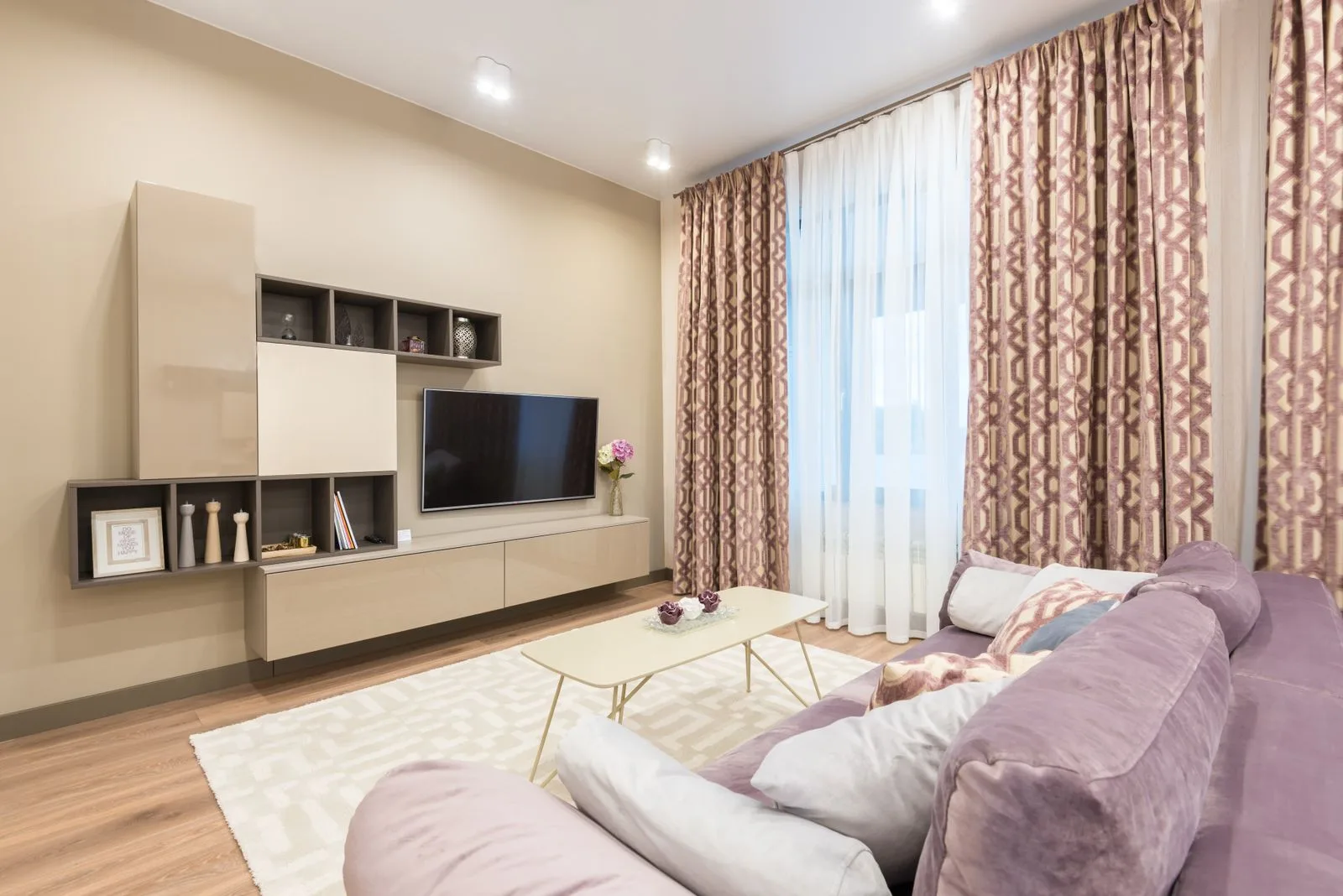
A floating console is a shelf that holds the TV boxes without touching the floor — and in a small room, that visible strip of floor underneath makes the whole wall feel lighter. Choose one no deeper than about 40 centimetres, a little wider than the TV, with closed doors to hide the router, the game console and the remotes. The photo shows a slim floating media console with wall-mounted cabinets and open shelves under a wall-mounted TV in a cozy living room, the floor beneath it completely clear.
Keep the console low and long rather than tall and deep: a tall entertainment unit eats floor space and blocks light, while a low console keeps the eye line down and makes the wall feel taller. Leave space around the boxes for air, so nothing overheats behind a closed door.
TV above a low storage bench
A low storage bench under the TV does two jobs at once: it holds the screen at the right height and it hides the things a small living room has nowhere else to put — spare throws, board games, chargers, the boxes the TV needs. The photo shows a wall-mounted TV above a long low dark-wood storage bench with drawers and an open shelf in a bright living room — the bench is low enough that the TV wall still feels light, and the drawers keep the clutter out of sight.
Pick a bench that is a little wider than the TV and no deeper than the sofa’s arm, so it never juts into the walkway. Keep the open shelf for the things you reach for daily and the drawers for the rest, and the TV wall stays calm instead of crowded.

Corner TV placement
When no wall faces the sofa — because the main wall has a window or a door — the corner is the TV’s best home. Angle the screen toward the seating and the corner stops being dead space and becomes the TV zone, leaving the long walls free for the sofa and the shelves. The photo shows the TV in the room’s window corner, on a low white stand and angled toward a dark corner sofa, the screen turned to face the seats instead of the wall.
Angle the sofa slightly toward the corner too, so nobody watches sideways, and use a swivel mount if the screen needs to turn between the sofa and an armchair. A corner stand can waste floor space if it is deep, so keep it low and no wider than the TV needs.

Hide the cables
Nothing makes a wall-mounted TV look unfinished like cables hanging down the wall — and in a small room, a tangle of black leads draws the eye faster than the screen itself. Hide them with a paintable cord cover that runs down to the console, or route them behind the console and along the skirting board, and the TV wall reads as one clean surface. The photo shows the result: a wall-mounted TV on a clean white and black wall above a low white cabinet, with no visible cables at all — just a tidy socket strip.
Do the cables before you hang anything else, because a cord cover is easy to fit when the wall is empty and a nuisance once the TV is up. Bundle the leads with reusable ties first, then cover them, so a single cable can be pulled out later without taking the whole cover down.

TV + bookshelf combo wall
A TV on a bare wall looks like a black hole; a TV sharing its wall with bookshelves looks like part of the room. Put the shelves on the same wall as the screen — books on one side, the TV in the middle, a low cabinet underneath — and the screen becomes one piece of a bigger arrangement instead of a dark rectangle on its own. The photo shows exactly that: a wall-mounted TV beside a grey bookshelf unit with books on the same living-room wall, above a low grey cabinet.
Keep the shelves shallow, about 25 to 30 centimetres deep, so they never crowd the walkway, and keep the books in one colour family with space between the stacks. The low cabinet underneath holds the TV boxes, so the shelves stay for books and a few calm objects instead of cables and chargers.

Right-size the TV for the room
A bigger TV is often the wrong buy in a small room. A screen that is too large for the distance you sit from it makes the whole wall feel like a cinema, leaves no room for shelves or breathing space, and makes the seating feel cramped. A common rule is to sit about 1.5 times the screen’s diagonal away from it — so measure the distance from the sofa to the TV wall before you shop, not after. The photo shows a couple sitting on a sofa watching a TV in a cozy brick-walled living room, at a comfortable distance from the screen.
For most small living rooms a 43 to 55 inch screen is the sweet spot, and the smaller end of that range suits the shortest rooms. If the screen you have already fills the wall, move the sofa back a few centimetres before you blame the TV — sometimes the distance is the problem, not the size.

Swivel mount
A fixed mount is fine when one sofa faces one wall, but a small living room rarely works that way — the sofa faces the TV, the armchair faces the window, and dinner happens at the table in the corner. A swivel mount lets the screen turn toward whoever is watching, then fold back flat against the wall when you are done. The photo shows the screen angled toward the seating on an adjustable pole mount in a cozy wood-panelled sitting area — the same idea as a wall swivel bracket, turning the TV toward two armchairs.
Check the mount’s weight rating and the screen size it supports, and make sure the mount folds back without the TV hitting the wall or the console. In a rented room, a freestanding pole mount with a swivel head gives you the same turn without drilling.

TV hidden in a cabinet
Some evenings you want the TV; most of the day you do not want to look at it. A TV set into a cabinet wall solves that — the screen sits inside built-in cabinetry, framed by closed cupboards above and below, so it reads as part of the furniture instead of a black rectangle on the wall. The photo shows a TV set into a built-in media wall with closed cabinets above and below in a modern living room — the screen blends into the furniture, though it is not hidden behind doors.
A true hideaway cabinet, with doors that close over the screen, works the same way and costs less than built-ins: a low cabinet with doors wide enough for the screen, the TV inside on a small stand. Either way, leave space for air around the screen and a way for the cables to reach the socket without showing.

Soundbar instead of bulky speakers
Big speakers are the TV’s hidden space tax: two tall boxes flanking the screen, a subwoofer on the floor, and cables between them. A slim soundbar does the same job from one low bar under the TV — better sound than the TV’s own speakers, no floor space lost, and nothing to trip over. The photo shows a slim black soundbar under a wall-mounted flat-screen TV on a low wooden bench, with no bulky speakers anywhere in the room.
Mount the soundbar on the wall just under the screen, or sit it on the console, and keep it the same width as the TV or a little narrower so the wall stays balanced. If the TV’s own speakers already sound fine to you in a small room, skip the soundbar entirely — the best space saver is the speaker you never buy.

How high should I mount a TV in a small living room?
A common guide puts the centre of the screen at seated eye level, roughly 42 inches (just over a metre) from the floor for most sofas. Sit on your sofa, look straight ahead, and mark that height on the wall before you drill — mounting too high strains your neck during long viewing.
What size TV is right for a small living room?
Measure the distance from the sofa to the TV wall first. A common rule is to sit about 1.5 times the screen’s diagonal away, so a 43 to 55 inch screen suits most small rooms. If the screen fills the wall and leaves no room for shelves, it is too big for the room.
Can I wall-mount a TV if I rent?
Only with your landlord’s permission, because mounting leaves holes to fill. If drilling is not allowed, use a freestanding TV mount on a pole or a slim console — both give you the wall-mounted look with no holes, as long as you check the weight limit and screen size first.
How do I hide TV cables without drilling?
Run them through a paintable cord cover down to the console, or route them behind the console and along the skirting board with reusable cable ties. An in-wall channel hides them completely but needs drilling, so it is not a renter’s option.
Is a corner TV a good idea in a small room?
Yes, when no wall faces the sofa — for example when the main wall has a window or a door. Angle the screen toward the seating with a swivel mount, keep the corner stand low and shallow, and angle the sofa slightly toward the corner so nobody watches sideways.
Do I need a soundbar in a small living room?
Not always — in a small room the TV’s own speakers are often enough. A slim soundbar is worth it if dialogue sounds thin or the room is noisy; it sits under the TV, takes no floor space, and replaces two bulky speakers and a subwoofer.
Final Thoughts
Small living room TV ideas that save real space work when the screen goes on the wall and the furniture under it stays slim: a wall mount or a swivel mount, a floating console or a low storage bench, cables hidden in a cord cover, and a soundbar instead of bulky speakers. Right-size the screen to the distance you sit from it, share the TV wall with bookshelves so the screen stops looking like a black hole, and hide the TV in cabinetry when you want the room back. The room does not get bigger — the TV just stops taking the space the sofa needs.
Save this post on Pinterest for your next living room refresh, and read our earlier living room ideas next: Small Living Room Ideas For Family Movie Nights, Small Living Room Seating Ideas That Feel Cozy, Small Living Room Rug Ideas That Define Each Zone, and Cozy Small Living Room Ideas For Calm Evenings.
Written from small-room living experience — every idea here is practical for a small living room, with a no-drill option wherever drilling is a problem.
Further reading: HGTV’s 12 stylish ways to decorate around your TV and House Beautiful’s TV wall ideas: 15 stylish and practical ways to display your TV show more floating console, bookshelf, and hidden TV ideas for the same small space.
Frequently Asked Questions
How deep should a floating console be under a wall-mounted TV?
Keep it 25 to 30 centimetres deep, so it holds the TV boxes without jutting into the walkway. A deeper console eats the floor the sofa needs, and a shallower one cannot hold the boxes. Mount it a little wider than the screen, low enough to leave a gap under it, and check the weight rating before you load it.
Can I put a TV above a low storage bench?
Yes, a low bench is one of the best TV bases because it stores blankets, games, and remotes while holding the screen at the right height. Pick a bench a little wider than the TV and no deeper than the sofa’s arm, so it never juts into the walkway. Keep the top clear, so the screen draws the eye.
What is the best way to hide a TV when it is off?
Use doors that close over the screen, a sliding panel, or a picture-style TV that shows art when it is off. A true hideaway cabinet works best in a small room, because the black screen disappears completely during the day. Keep the doors light and easy to open, so hiding the TV never becomes a chore you skip.
Should the soundbar go on the wall or on the console?
Mount it on the wall under the screen when you can, so it points at ears and leaves the console top clear. Sitting it on the console works too, if the console is deep enough and the soundbar is no wider than the TV. Either way, keep it centred under the screen, and hide its cable with the TV cables.
How do I keep the TV wall from looking like a black hole?
Share the wall with shallow bookshelves, framed art, or a plant, so the screen becomes one object among several. Keep the shelves 25 to 30 centimetres deep, so they never crowd the walkway, and leave some empty space, so the wall breathes. A slim console under the TV grounds the wall, and the black screen stops dominating the room.


