
Small Pantry Storage Ideas For Tiny Kitchens
Small pantry storage ideas for tiny kitchens start with one simple truth: a small pantry is not the problem — a small pantry with no system is. One cabinet, one closet, or one wall of shelves can hold a week’s cooking, but only if every category has a fixed home, every jar can be seen into, and nothing hides at the back of a deep shelf for six months. Give the pantry zones, label them simply, and check it weekly, and the tiny kitchen stops buying duplicates and stops losing food to the back of the shelf.
The ideas below build that system in the order that matters: jars and baskets first, then the door and the deep corners, then the habits that keep it working.
Last updated 14 Nov 2026. Refresh in 3–6 months: re-check the jars for stale food and worn labels, and re-map the zones if your cooking has changed.

Key Takeaways
- Zone the pantry by how often you cook, not by food type — everyday things at eye level, weekly things one shelf up or down, backstock high or low.
- Decant only what goes stale in bags into matching clear jars, and label the jars on the front so anyone can find things and put them back.
- Deep shelves need containers that slide — a basket or bin that pulls out turns the dark back of a shelf into usable space.
- A weekly pantry check before shopping stops duplicates: check the zones, write the list from what is actually missing, and shop from the list.
Matching clear jars with labels
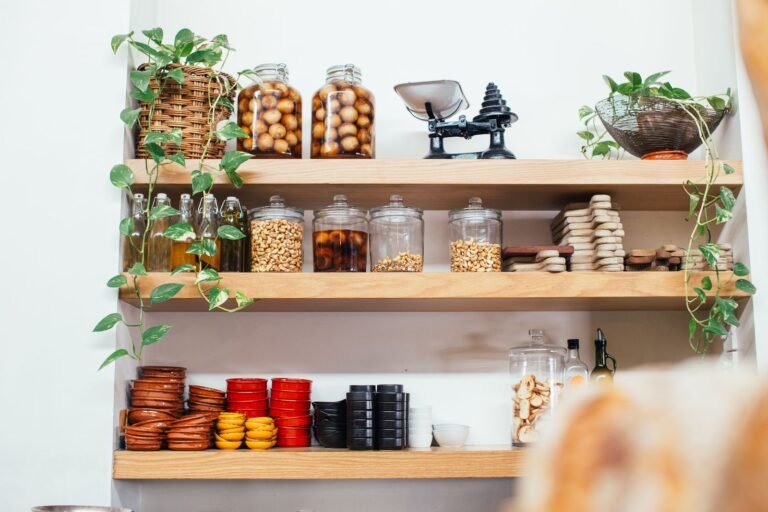
Matching clear jars are the fastest way to make a tiny pantry look calm and work properly: you can see at a glance what is inside and how much is left, the jars stack neatly instead of tipping, and a lidded jar keeps flour, rice and pasta fresher than a folded packet. The photo shows the idea in full: white pantry shelving filled with matching labelled clear glass jars of grains, seeds and oats, every jar readable from the front.
Label each jar on the front, not the lid, with the contents and the date you decanted it, and choose one jar shape in two or three sizes so they stack.

A door-mounted spice rack
Spices are the pantry’s worst space-wasters: small jars, all different shapes, lost at the back of a shelf where you cannot see them and cannot reach them. A door-mounted spice rack moves them out of the shelves entirely — the jars live on the inside of the pantry door, visible in one row, reachable in one movement, and the shelf space they used to take is free for bigger things. The photo shows the spice rack itself, standing on a countertop rather than mounted on a door: a rustic blue wooden spice rack with rows of spice jars on a wooden kitchen countertop, the jars in a neat row instead of a jumble.
Keep the door rack to light things — spices, small packets, sauce sachets — and measure the door clearance first, so the rack does not stop the door closing.

Shelf risers to double shelf space
A pantry shelf is wasted space by default: one row of jars on the shelf, and a whole shelf-height of empty air above them. A shelf riser doubles that shelf — a small stepped stand that sits on the shelf, so cans and jars live underneath it and on top of it, and the vertical space you already own finally gets used. The photo shows the doubled space rather than the riser itself: an open kitchen cupboard with stacked tiers of dry-goods jars, plates on a rack and bowls below, the cupboard using its full height instead of one row.
Buy the riser after you know your shelf height, not before — measure the gap between shelves, and choose a riser that leaves room for the tallest jar underneath it. In a rented kitchen, a freestanding riser is ideal: it sits on the shelf, needs no screws, and moves with you.

Baskets by category (breakfast, baking, snacks)
Loose packets are the pantry’s chaos: half-open bags of snacks, baking mixes and breakfast bars slide around, fall over, and hide the things behind them. One basket per category fixes that — breakfast in one basket, baking in another, snacks in a third — and each basket pulls out like a drawer, so you can see everything in it without unpacking the shelf. The photo shows the baskets in place: white pantry shelves with wicker baskets holding onions, peaches and potatoes beside pasta and grain jars, each basket holding one category.
Keep the categories broad — breakfast, baking, snacks, cans — rather than naming every item, because broad labels survive a change in shopping. Label the basket on the front, and keep the basket to the depth of the shelf so it slides out fully.

Turntable (lazy Susan) in deep corners
Deep corners are where pantry food goes to die: jars pushed to the back, forgotten, and found a year later past their date. A turntable — a lazy Susan — fixes the corner: put the oils, vinegars, sauces and small jars on the spinning tray, and one turn brings the back to the front. The photo shows the turntable in use: a rotating spice rack carousel with labelled spice jars on a white kitchen countertop beside a utensil jar, the jars in a circle that spins instead of a row that hides.
Choose a turntable that fits the shelf depth with room to spin — measure the shelf before you buy, because a turntable that catches on the shelf edge is worse than no turntable at all. Keep the turntable to one category, and keep the tallest bottles in the centre so they do not tip when the tray turns.

Hooks under shelves for mugs
Mugs take up shelf space that a tiny pantry cannot spare, and they are the first thing to get chipped when a cupboard is overcrowded. Hooks under a shelf solve both problems: the mugs hang in the air, the shelf stays free for jars and baskets, and the mugs look like part of the kitchen rather than clutter. The photo shows the hooks doing their job: three colourful ceramic mugs hanging by their handles from metal hooks, each mug visible and reachable instead of stacked inside another mug.
Use small cup hooks screwed into the underside of the shelf, or a stick-on hook rail if you rent and cannot drill — and hang only the mugs you use daily, two or three in one colour if you can. Keep the rest in a cupboard.

Small containers and clips for half-used packets
Half-used packets are the pantry’s slow leak: a bag of pasta folded over, a packet of nuts clipped shut, a bag of flour that slowly spills every time the shelf is bumped. Small containers and clips fix that — decant the half-used packet into a small lidded container, or seal it with a proper clip, and the packet stops spilling, stops going stale, and stops taking up more space than its contents. The photo shows the containers: stacked clear plastic containers with orange lids holding nuts, seeds and grains on a shelf, each one sealed and stackable.
Keep a small box of clips and a few spare containers in the pantry itself, so sealing a packet takes seconds rather than a trip to another cupboard.

Daily items at eye level
A pantry that makes you reach or crouch for the things you use every day is a pantry you will stop using properly — you will leave the daily things on the counter instead, and the counter will fill up. Put the daily items at eye level: breakfast, cooking staples, the tea and coffee, the things you reach for every morning, all on the shelf you can see without stretching or bending. The photo shows that shelf: a close-up of wooden pantry shelves with glass jars of sugar, spices and dry goods at eye level, everything readable at a glance.
Work outward from eye level: weekly things one shelf up or down, backstock high or low, and heavy things on the lowest shelf where they are safe to lift.

A small step stool for high shelves
High shelves are only useful if you can reach them — and in a tiny kitchen, the top shelf is usually the one that holds the things you need once a month and cannot reach without climbing on a chair. A small step stool fixes that: a two-step stool that lives in the kitchen, tucked beside the fridge or behind the door, so the high shelf is always reachable. The photo shows the stool itself: a white two-step step stool with ceramic storage jars on it in bright sunlight, the stool doubling as a display surface when it is not in use.
Choose a stool that folds flat or tucks away, so it never blocks the walkway, and keep it in the kitchen — a stool that lives in another room is a stool you will not fetch.

Weekly pantry check before shopping
A pantry system only works if it is checked, and the check takes ten minutes once a week: open the pantry before you shop, look at each zone, and write the shopping list from what is actually missing — not from what you think is missing. The photo shows the check itself: a woman in a pink shirt writing in a notebook on a kitchen counter with a glass jar beside her, the list being written before the shop, not after. When the list comes from the pantry, you stop buying a third bag of rice while the second one sits unopened at the back.
Do the check on the same day every week, and make it part of the routine: wipe the shelves, check the dates on the front row, return strays to their baskets, and note the empty zones.

How do I organise a tiny pantry with no walk-in?
Zone one cabinet or closet by how often you cook: everyday things at eye level, weekly things one shelf up or down, backstock high or low. Add baskets by category, a door rack for spices, and a turntable for deep corners — no walk-in needed.
Should I decant everything into matching jars?
No — decant only what you use every week and what goes stale in bags, like flour, rice, oats and cereal. Keep the rest in its packet until it earns a jar, and keep cooking instructions and expiry dates nearby for anything you decant.
How do I stop food getting lost at the back of deep shelves?
Use containers that slide — a basket or bin that pulls out like a drawer — and a turntable for deep corners, so one spin brings the back to the front. Put new items behind older ones, and do a weekly check before shopping.
What is the best way to label a pantry?
Label the zone or the bin, not every single item, when space is tight — “Breakfast”, “Grains”, “Snacks” on the basket, and item labels only on jars that look alike, like flour and sugar. Add an opened-on date to jars of flour, cereal and nuts.
How do I organise spices in a small kitchen?
On the inside of the pantry door, in a slim rack, or in a shallow drawer with jars lying flat and labels facing up. Keep heavy jars on the shelves and light spice jars on the door, and measure the door clearance before you buy the rack.
How often should I check my pantry?
Once a week, before shopping, for ten minutes: wipe the shelves, check the dates on the front row, return strays to their baskets, and write the shopping list from what is actually missing. A monthly check catches anything the weekly one missed.
Final Thoughts
Small pantry storage ideas for tiny kitchens work when the pantry has a system, not just a tidy shelf: matching jars you can see into, a spice rack on the door, risers that double each shelf, baskets by category, and a turntable for the deep corners. Daily things live at eye level, half-used packets get sealed in small containers, a step stool reaches the high shelf, and a weekly check before shopping keeps the whole thing working. The kitchen does not get bigger — the pantry just stops wasting food and space.
Save this post on Pinterest for your next kitchen refresh, and read our earlier kitchen and storage ideas next: Small Entryway Storage Ideas For Tiny Hallways, Small Space Storage Systems That Stay Tidy Daily, Budget Small Space Storage Ideas That Save Money, and Small Kitchen Corner Ideas For Cosy Coffee Mornings.
Written from small-room living experience — every idea here is renter-friendly and needs no renovation.
Further reading: HGTV’s 59 organizers for a picture-perfect pantry and IKEA’s how to organize with 6 pantry storage tips for your kitchen show more jar, basket, and turntable ideas for the same tiny space.
Frequently Asked Questions
What size shelf riser fits a tiny pantry?
Measure the gap between shelves, then buy a riser that leaves room for tall jars on the lower level and the shortest item on the riser. A riser that is too tall wastes the shelf above it, and one too short hides the jars behind it. Choose a wide riser, so nothing wobbles when you pull a jar out.
Can I use a turntable on a narrow pantry shelf?
Yes, if the shelf is at least as deep as the turntable, with a little room to spin. Measure the shelf depth before you buy, and leave a finger’s width around the edge, so the turntable never catches on the shelf front. Use it for oils, sauces, and small jars, and keep heavy items off it, so it spins freely.
Where should heavy pantry items go?
Keep heavy items on a low shelf, close to waist height, so you never lift a jar above your head or reach up with a heavy tin. Put backstock low too, and keep the top shelf for light, rarely used items. That way the pantry stays safe to use, and the daily items at eye level stay easy to reach.
How do I stop half-used packets spilling in the pantry?
Seal every packet with a clip as soon as you use it, and move contents into a small labelled container when the bag gets low. Keep a box of clips and containers inside the pantry, so sealing takes seconds and never becomes a job you put off. Check the clips each week, and replace any that have lost their grip.
How should I store mugs in a tiny pantry?
Hang mugs from hooks under a shelf, so they use the air space below the shelf instead of taking a whole shelf row. Use small cup hooks screwed into the shelf, or a stick-on hook rail if you rent. Keep the hooks to light mugs only, and leave enough room between them, so the mugs never knock together and chip.



One Comment