Small Space Toy Storage Ideas That Hide The Mess
Small space toy storage ideas that hide the mess start with one simple truth: the problem is rarely the storage — it is the volume. Toys arrive in waves, small parts migrate between rooms, and a child who owns fifty toys will play with about twelve of them. Put fewer toys out, give each type one home a child can reach, and rotate the rest, and the living room stops looking like a toy shop exploded — without a playroom, without new furniture, and without taking the toys away.
The ideas below are built for a child, not for an adult’s idea of tidy: low shelves a small person can reach, labels with pictures instead of words, bins shallow enough to carry, and a tidy-up routine that takes five minutes and feels like a game.
Last updated 14 Nov 2026. Refresh in 3–6 months: re-check the labels as the toys change, and rotate the display shelf when favourites change.
Key Takeaways
- Keep fewer toys out — a small set on low shelves, the rest in rotation boxes out of sight, swapped weekly.
- One basket per toy type, labelled with a picture and a word, at a height a child can reach without help.
- Open bins low, lidded bins high: a toddler can drop blocks into an open bin but cannot work a latch.
- A 5-minute tidy-up every evening beats a big clean-up every weekend — and one in, one out keeps the volume from growing back.
One basket per toy type, labelled with pictures
A basket that holds “everything” holds nothing a child can find — they tip the whole thing out to reach the one toy at the bottom, and the floor is covered again. One basket per toy type fixes that: blocks in one basket, dolls in another, cars in a third, and each basket labelled with a picture of what lives inside plus the word, so a child who cannot read yet can still match the picture. The photo shows the labelling in action: colourful blue and orange bins of children’s books on a wooden shelf, one orange bin labelled ‘Used Books’ — the label tells you what is inside without opening it.
Keep the baskets shallow and light enough for a small child to carry, and keep the labels at the child’s eye level on the front of the bin.

Low open shelves kids can reach
A tall bookshelf with bins on the top shelf is a storage system for adults. A low toy shelf with open bins at knee height is a storage system for a child. When the shelf is low enough to reach without climbing, a child can choose a toy, play with it, and put it back — three things that never happen when the toys live above their head. The photo shows exactly that: a young girl reaching into a low pink open cube shelf with books, toys and a fabric storage box in a nursery, everything at her height.
Pick a shelf that is stable and low — two cubes high is plenty — and anchor it to the wall if it is tall enough to tip. Keep the open bins on the bottom shelf for the toys in rotation, and save lidded bins for the top, out of reach.

Toy rotation box swapped weekly
Too many toys out at once overwhelms a child — they play less purposefully, they lose pieces, and tidying becomes a mountain. A rotation box fixes it: keep a small set out on the shelves, pack the rest into three or four lidded boxes, and swap one box in every week. The toys that come back feel new, the child plays with them longer, and the living room only ever holds a third of the collection. The photo shows the swap in progress: a child sitting inside an open wooden toy chest playing with toys beside a bed, the chest holding the toys that are out this week.
Number the boxes and note on each lid when it last came out, so no box is forgotten for months. And keep each box a mix — something to build, something for pretend play, a puzzle, a vehicle — so any box can stand in for the shelf without leaving a gap.

A toy hammock or net in the corner
Soft toys are the hardest toys to store: they are bulky, they do not stack, and a basket big enough for all of them takes up half the room. A net or hammock strung across a corner lifts them up off the floor — the soft toys live in the net, visible and reachable, and the floor stays clear. The photo shows an indoor hammock in use rather than a storage net: a young girl sitting in a striped indoor hammock surrounded by colourful balloons — the same kind of netting, hung in a corner, becomes a soft-toy store when it holds teddies instead of a child.
Hang the net high enough that it does not block the walkway, and keep it to soft toys only — anything heavy will sag the net and pull the hooks out.

Rolling cart for craft supplies
Craft supplies are the messiest toys of all: paper, pens, glue, stickers and scissors spread across every surface in the house the moment a project starts. A rolling cart gives them one home on wheels — three tiers of supplies that roll to the table when it is craft time and roll back to the corner when it is done. The photo shows the cart itself: a wooden three-tier rolling cart on wheels, here holding folded towels and bath products in a shop-like setting — the same wheeled tiers, filled with paper and pens instead, become the craft station.
Keep the cart’s top tier for the things in use today and the lower tiers for the spares, and give the cart a parking spot — a corner it always returns to, so it never becomes a permanent table in the middle of the room.

Books forward-facing in a low crate
Books with their spines out are invisible to a small child — they cannot read the titles, so they pull every book out to find the one they want. Books with their covers facing forward are a shop window: the child sees the cover, chooses the book, and puts it back in the same slot. The photo shows exactly that: children’s books displayed cover-forward on a low wooden book stand, the front cover ‘Ms. LaGrange is Strange!’ facing out, the books at a height a child can browse.
The rest live in a box on a higher shelf, swapped in with the toy rotation.

Soft toy net or basket by the bed
Bedtime is when soft toys matter most, and it is also when they are hardest to find — one under the bed, one behind the curtain, one in the living room. A soft toy basket by the bed keeps them in one place: the child picks one for the night, the rest stay in the basket, and in the morning they all go back. The photo shows the basket doing its job: a woven seagrass basket full of soft stuffed toys beside a bed with white bedding, the toys contained and visible instead of scattered across the room.
Keep the basket to the soft toys, and keep it small enough that it holds a dozen, not fifty — when the basket is full, something has to go before anything new joins it.

A 5-minute tidy-up routine
A big weekend clean-up never works with children, because it is too long, too boring, and too late — the mess has already won by then. A five-minute tidy-up every evening works, because it is short enough to be a game: set a timer, put on a song, and race to get every toy back to its basket before the music stops. The photo shows the routine in action: a young girl putting wooden toy blocks into a large woven basket on the floor, the tidy-up happening one toy at a time.
Do it at the same time every day — after dinner, before bath time — so it becomes part of the evening, not a punishment. A five-minute tidy-up that happens every day beats a one-hour clean-up that happens once a month, and a child who tidies for five minutes a day grows up knowing where things live.

One display shelf for favourites
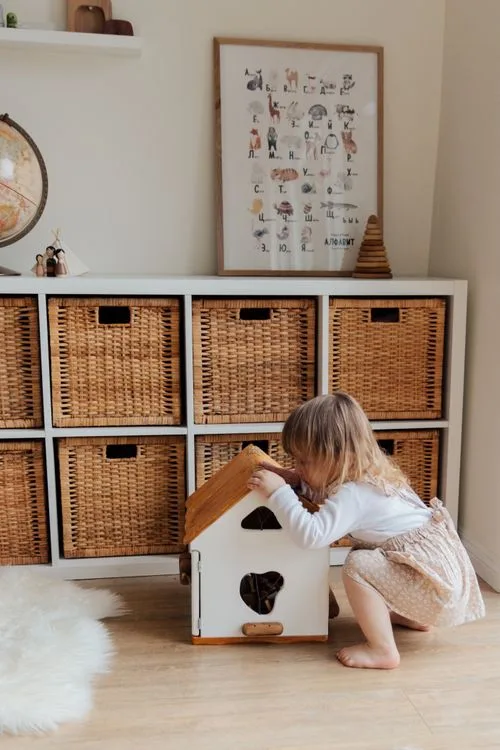
Not every toy is for playing with — some are for looking at. A single display shelf, high enough to be out of the play zone, holds the favourites: the wooden toys, the nesting dolls, the special elephant, the things a child loves to see but does not need to grab every day. The photo shows that shelf: a white wall shelf displaying favourite wooden toys, nesting dolls and an elephant above a globe and wicker baskets, the special things given a place of their own.
Keep the display shelf to one shelf and a handful of items — when everything is on display, nothing is special, and the shelf becomes another storage shelf.

Donate box — one in, one out
Toys arrive faster than children outgrow them — birthdays, holidays, grandparents — and without an exit, the volume only grows. A donate box is the exit: one box, always in the house, and when a new toy arrives, an old one goes into the box. The photo shows the box itself: a cardboard box labelled ‘Donations’ filled with plush bunny and polar bear toys and pillows, the outgrown toys packed and ready to go to another child.
Let older children help choose what goes in the box, but do the broken-and-recalled pass yourself — check secondhand and older toys against the recall list before passing them on.

How do I store toys in a small living room?
Keep fewer toys out — a small set on low shelves, the rest in rotation boxes out of sight. One basket per toy type, labelled with a picture, at a height a child can reach. A storage ottoman or a lidded basket by the sofa hides the rest in seconds.
How often should I rotate toys?
Every one to two weeks is common for younger children, every two to four weeks for older ones. Swap sooner if the child loses interest, later if they are deep in a project. Keep each rotation box a mix of play types so any box can stand in for the shelf.
How do I label toy bins for kids who cannot read?
Put a picture of the contents next to the word, on the front of the bin at the child’s eye level. A photo of blocks on the block bin, a photo of dolls on the doll bin. Change the label when the contents change.
What is the best toy storage for a toddler?
Low open shelves with shallow, open bins a toddler can reach and carry. Open bins low, lidded bins high — a toddler can drop blocks into an open bin but cannot work a latch. Pick shallow bins over deep ones, since children tip a deep bin out to find anything in it.
How do I get my child to tidy up toys?
Make it short and regular: a 5-minute tidy-up every evening, at the same time, with a song or a timer. Keep the target small — the floor clear, not the shelves perfect — and make sure every toy has a labelled home, so the child knows where things go.
How many toys should a child have out?
Fewer than you think. In a 2018 study, toddlers given four toys played with each one longer and in more varied ways than toddlers given sixteen. A small set out, the rest in rotation, means more play and less mess.
Final Thoughts
Small space toy storage ideas that hide the mess work when fewer toys are out and every toy has a home a child can reach: one basket per type with a picture label, low open shelves, a rotation box swapped weekly, and a five-minute tidy-up every evening. Soft toys live in a net or a basket by the bed, books face forward in a low crate, craft supplies roll on a cart, and the donate box keeps the volume from growing back. The room does not get bigger — it just stops being a toy shop floor.
Save this post on Pinterest for your next playroom refresh, and read our earlier storage and living room ideas next: Small Space Storage Ideas That Use Every Wall, Studio Apartment Storage Ideas That Feel Cozy, Small Space Laundry Storage Ideas That Keep It Tidy, and Cozy Small Living Room Ideas For Calm Evenings.
Written from small-room living experience — every idea here is renter-friendly and needs no renovation.
Further reading: HGTV’s 37 smart toy storage ideas and IKEA’s creative toy storage ideas for toddlers and children show more basket, cube, and rolling cart ideas for the same small space.
Frequently Asked Questions
How high should toy shelves be for a small child?
Keep shelves at a height your child can reach without a step or an adult’s help, usually two cubes high for a toddler. Higher shelves belong to lidded bins and backstock, not daily toys. Anchor every shelf to the wall, so it cannot tip when a child pulls a basket out, and keep the top clear.
What should go in a rolling craft cart?
Keep the top tier for the supplies in use today, and the lower tiers for spares, so the cart rolls to the table without a trip. Give the cart one job, craft supplies, so it never becomes a dumping ground for random toys. Lock the wheels when it is in use, and roll it against a wall when playtime ends.
How should I store books so a small child can choose one?
Stand books forward-facing in a low crate or on a low shelf, so a child can see the covers and choose without pulling every book out. Keep ten to twelve books out at a time, and swap the rest with the toy rotation. Put the crate where the child reads, not where it looks tidy to an adult.
Where should soft toys sleep at night?
Keep a basket of soft toys by the bed, holding a dozen, so the favourite is easy to find at bedtime. The rest belong in a net in a corner or in a rotation box, not piled on the bed. When the basket overflows, it is time to choose a few to donate, and the bed stays clear for sleep.
What should go in the toy donate box first?
Put broken toys, recalled toys, duplicates, and anything outgrown in the donate box first, before you ask a child to choose. Let older children help choose the rest, but do the safety pass yourself, because a child cannot check recalls. Keep the box by the door, so it leaves the house before it drifts back onto a shelf.