
Small Bedroom Colour Ideas Without Painting Walls
Small bedroom colour ideas without painting walls start with one simple truth: colour you can take with you when you move is the only colour a rented small bedroom needs. One accent colour repeated in the bedding, the curtains and a cushion changes the whole room, and nothing touches the walls at all — no paint, no drilling, no deposit at risk. The 2026 palettes for small bedrooms are soft and warm: dusty rose and blush, muted mauve, soft blue, sage and clay, all of which work beautifully in textiles against light walls.
The ten ideas below use textiles and accessories only — bedding, cushions, throws, curtains, a tray, a lamp — and they are ordered from the fastest win to the finishing rule. Pick one accent colour, repeat it three times, and the room looks like someone chose it on purpose.

Key Takeaways
- Pick one accent colour and repeat it three times — bedding, curtain, cushion — so the room looks planned.
- Keep the big pieces neutral and put the colour in the small ones, so the room never feels crowded.
- A bold duvet cover is the fastest colour change in the house, and it comes off in minutes.
- Colour lives in textiles and accessories only — never on rented walls — and one colour plus white beats three colours competing.
Tip 1 — Pick one accent colour and repeat it three times
Pick one accent colour and repeat it three times — bedding, curtain, cushion — and the room instantly looks planned instead of collected. A dusty rose duvet cover, dusty rose curtains and one dusty rose cushion tell the eye the same story three times, and the repetition is what makes a small room feel calm rather than busy. The colour does not need to match exactly: three shades of the same family — a deep rose, a soft blush, a muted mauve — work better than one flat shade repeated like a uniform. The photo shows the repeat in its simplest form — blue on the cushions against a blue-grey wall, where the cushions carry the colour and the wall stays quiet.
Choose the accent from something you already love, not from a trend chart: a cushion you already own, a throw you reach for, a book cover on the nightstand. If the colour is already in the room somewhere, repeating it feels natural; if it comes from nowhere, it feels decorated. One colour, three places, and the room has a scheme.

Tip 2 — Neutrals on the big pieces, colour in the small ones
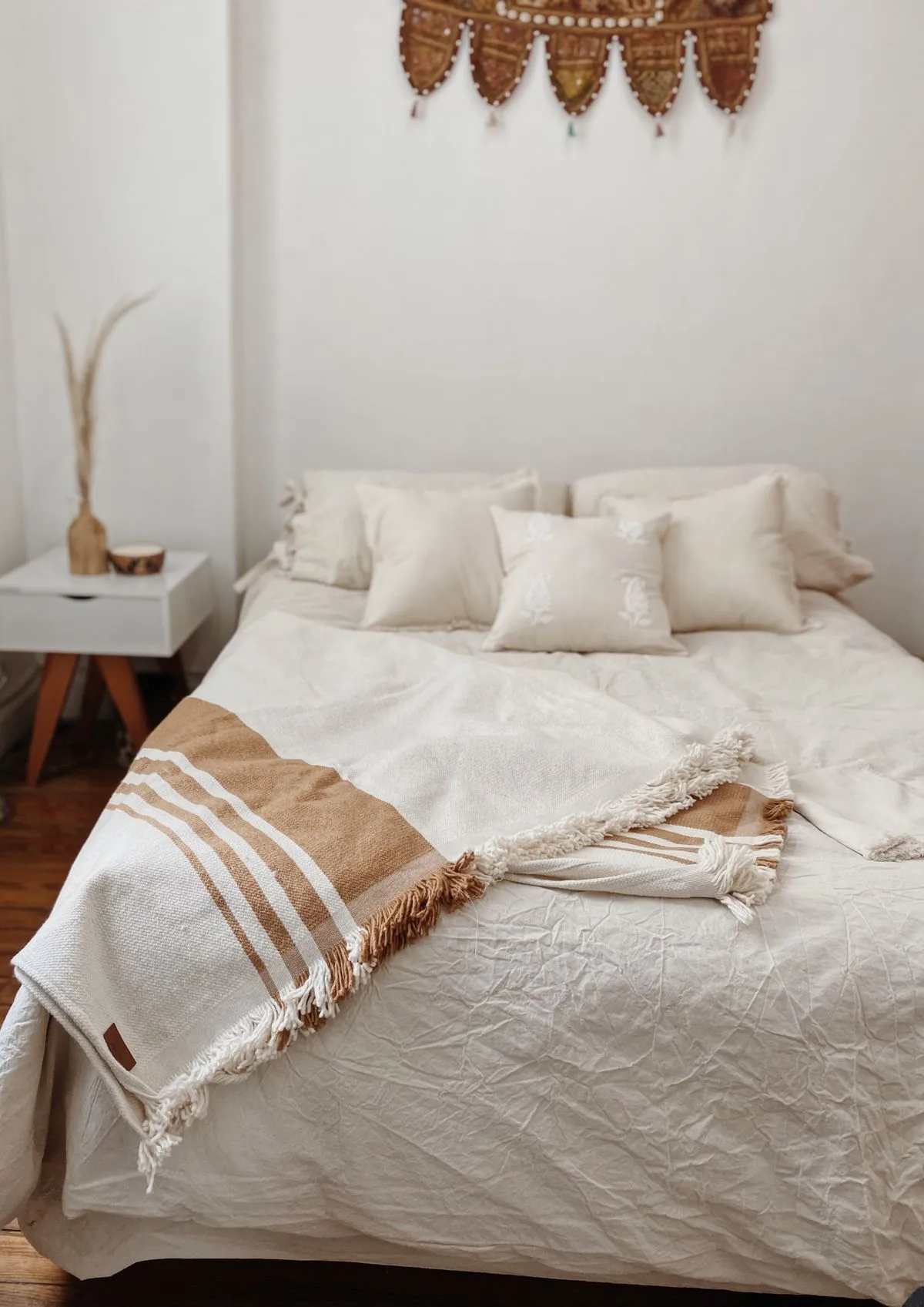
Keep neutrals on the big pieces and put the colour in the small ones, because the big pieces are the ones that crowd a small room. A white or warm-white bed, a plain wardrobe and a light floor give the room its calm base, and the colour lives in the cushions, the throw, the lamp and the tray — the things you can pick up and move. When the colour is small, it pops; when the colour is big, it presses in on the walls. The photo shows the quieter version of the rule — a beige striped throw doing the accent job softly against a white bed, rather than a bold pop of colour.
This rule also protects your money: neutral bedding and curtains last for years, while a coloured cushion or throw is cheap to swap when the season changes. Buy the big pieces once in white, oatmeal or sand, and buy the colour in the small pieces you can change in an afternoon. Neutrals on the big pieces, colour in the small ones, and the room stays light and flexible.
Tip 3 — A bold duvet cover is the fastest colour change
Buy a bold duvet cover, and the room changes colour in the time it takes to make the bed. The bed is the biggest surface in a small bedroom, so the duvet cover is the biggest colour decision you will make — bigger than any cushion, curtain or rug. A deep clay cover, a soft blue cover, a dusty rose cover: one bold choice, and the whole room follows it, because everything else in the room is neutral by design. The photo shows a bold blue quilted bedspread doing exactly this job — the duvet itself is the colour, and the room needs nothing else.
Keep two duvet covers in your accent colour, one on the bed and one in the wash, so the colour never disappears on laundry day. And keep the rest of the bedding plain — white sheets, a plain pillowcase — so the duvet cover is the one strong statement and the room never argues with itself. One bold duvet cover, changed in minutes, and the room has a new colour.

Tip 4 — Coloured cushions and one throw do the work as a set
Buy coloured cushions and one throw as a set, and the set does the work that three separate purchases never do. Two cushions in the accent colour and one throw in the same family — laid across the foot of the bed or folded over the arm of a chair — give the room a finished edge, because the pieces were chosen to sit together. A cushion on its own is a spot of colour; a cushion plus a throw is a scheme. The photo shows the cushions doing the work — the throw reads as a dark check pillow rather than a separate throw, so think of the set as cushions first and add the throw as the third piece.
Keep the cushion count low: two cushions and one throw is enough in a small bedroom, and a pile of six cushions is clutter that has to be moved every night. Choose a throw in a texture that adds warmth — a chunky knit, a soft fleece, a woven cotton — because texture is part of the colour story in a room this small. One set, two cushions, one throw, and the bed looks dressed.

Tip 5 — One coloured tray or lamp, not five
Add one coloured tray or lamp, not five, because one strong accent object is a statement and five are a mess. A tray in your accent colour on the nightstand, or a lamp with a coloured base beside the bed, gives the room a second colour anchor after the bedding — a small, deliberate spot of colour at eye level. The photo shows a gold tray with a candle, a book and a mug on a white bed — gold is the one colour here, and the tray sits on the bed itself rather than a side table, which works just as well in a room with no spare surface.
Resist the urge to match everything: one coloured tray plus one coloured lamp is already two, and the third coloured object is the one that tips the room from styled to crowded. Keep the tray or lamp in the same colour family as the bedding, so the room has one colour story, not two. One coloured object, chosen on purpose, and the room has a focal point.

Tip 6 — A seasonal swap, one textile set for winter and one for summer
Keep two textile sets — one for winter, one for summer — and the room changes with the season for the price of one shopping trip. A warm set for the cold months, in dusty rose, clay or a deep sage, with a heavier throw and a thicker duvet cover; a light set for the warm months, in soft blue, pale blush or white, with a light coverlet and a thin throw. Swap the duvet cover, the cushions and the throw in one go, and the room feels like a different room on the same day. The photo shows one crisp white set, neatly folded in a stack — the summer half of the pair, with the winter set stored away.
Store the off-season set in one box on top of the wardrobe or under the bed, so the swap takes ten minutes and nothing gets lost. Wash both sets before you store them, and the fresh set always smells like new. One swap a year, two sets, and the room never feels tired of its own colour.

Tip 7 — Keep the floor and walls light so the colour pops
Keep the floor and the walls light, so the colour has something to pop against. A pale floor and white or warm-white walls are the quiet background that makes a dusty rose cushion or a clay throw look rich instead of muddy, and in a small bedroom the light background also keeps the room feeling bigger. Dark walls and dark floors swallow colour; light walls and light floors let one accent colour do all the talking. The photo shows a bright white bedroom with a white bed and built-in shelving — light walls, light floor, and the colour is free to arrive in the textiles.
If the floor is dark wood or the walls are already a strong colour, do not fight them — lighten the room with textiles instead, using a pale rug and white bedding to lift the base. The rule is about contrast, not about repainting: the accent needs a calm surface behind it, and the calmest surface you already own is the one to use. Light floor, light walls, one strong colour, and the room breathes.

Tip 8 — Test the accent in daylight and lamplight before committing
Test the accent colour in daylight and in lamplight before you commit to it, because a colour that looks soft in the shop can look loud at home. Hold the duvet cover or cushion up in the morning light by the window, then again in the evening under the bedside lamp — warm lamplight turns cool blues grey and turns dusty rose warmer, and a colour that looked perfect at noon can look tired at 9pm. The photo shows a bedside table with a lit lamp, a candle and books in bright sunlight — the two lights a colour has to survive, daylight and lamplight, in one frame.
Buy one cushion first, live with it for a week, and only then buy the duvet cover and the throw to match. A week of living with the colour tells you more than an hour in the shop ever will, and one cushion is a cheap test. Test in both lights, wait a week, and the colour you commit to is the colour you will still like in six months.

Tip 9 — If renting, colour lives in textiles and accessories, never on the walls
If you are renting, keep the colour in textiles and accessories, never on the walls — that is the whole renter rule, and it protects your deposit. A landlord can ask you to repaint a wall, but nobody can ask you to un-buy a duvet cover, and every idea in this post works without a single mark on the wall: bedding, curtains, cushions, a throw, a tray, a lamp. Even the curtain rail can be a tension rod that leaves no holes. The photo shows a white room kept white, with the colour living entirely in the textiles — the renter rule itself is not something a photo can show, but the result is: a coloured room with untouched walls.
When you move, the colour moves with you — the duvet cover, the cushions and the throw pack into one box, and the next room gets the same scheme on day one. That is the real advantage of textile colour: it is yours, not the landlord’s, and it follows you. Textiles, accessories, nothing on the walls, and your deposit stays safe.

Tip 10 — When in doubt, one colour plus white beats three colours competing
When in doubt, choose one colour plus white — it beats three colours competing every time. A small bedroom has no room for a colour argument: three strong colours in one tiny space fight for attention, and the room feels busy instead of calm. One accent colour — dusty rose, soft blue, sage or clay — against white bedding, white walls and a white throw is a complete scheme, and the white gives the colour room to breathe. The photo shows white bedding against a plain light blue wall — the one-colour-plus-white rule in its cleanest form, with the blue doing all the colour work.
If you love two colours, use one as the accent and the other as a whisper — a sage cushion with a dusty rose throw, say, where the rose leads and the sage follows. But never let two colours shout at the same volume. One colour plus white, and the room looks like someone chose it on purpose.

FAQ
How can I add colour to a small bedroom without painting?
Use textiles and accessories only: one accent colour in the duvet cover, the curtains and a cushion, plus a throw and one coloured tray or lamp. Nothing touches the walls, so the colour is renter-safe and it all moves with you.
What is the best accent colour for a small bedroom in 2026?
The 2026 palettes are dusty rose and blush, muted mauve, soft blue, sage and clay — all soft, warm colours that work in textiles against light walls. Pick the one you already love, repeat it three times, and keep the big pieces neutral.
What is colour drenching, and can renters do it?
Colour drenching is the bold 2026 look of one saturated colour wrapped around a whole room — walls, ceiling, woodwork and all. Renters can do the textile version: drench the bed, the curtains, the cushions and the throw in one deep colour, and the room gets the same enveloping feel with no paint at all.
How many colours should a small bedroom have?
One accent colour plus white is the safest scheme, and two at most — one leading, one whispering. Three strong colours competing in a tiny room feel busy, while one colour repeated three times feels calm and planned.
How do I test a bedroom colour before committing?
Buy one cushion first and live with it for a week, checking it in morning daylight and in warm evening lamplight. Warm light changes cool colours, so a colour that looks right at noon can look tired at 9pm — the week-long test catches that before you buy the full set.
Can I change my bedroom colour for the seasons?
Yes — keep two textile sets, one warm set for winter and one light set for summer, and swap the duvet cover, cushions and throw in one go. Store the off-season set in one box under the bed, and the swap takes ten minutes.
Final Thoughts
Small bedroom colour ideas without painting walls work when one accent colour does all the work: pick dusty rose, soft blue, sage or clay, repeat it three times in the bedding, the curtains and a cushion, keep the big pieces neutral, and let a bold duvet cover carry the change. Swap the textile set with the seasons, test the colour in daylight and lamplight, and if you are renting, keep the colour in textiles and accessories, never on the walls. One colour plus white beats three colours competing, and the whole scheme packs into one box when you move.
Save this post on Pinterest for your next colour refresh, and read our earlier bedroom colour ideas next: Small Bedroom Colour Ideas That Make It Feel Bigger, Neutral Bedroom Ideas For A Calm Cozy Retreat, Small Bathroom Colour Ideas Without New Paint, and Small Bedroom Bedding Ideas For A Cozy Night In.
More inspiration: Small Bedroom Ideas and Bedding.
Written from small-room living experience — every idea here is practical for a tiny bedroom, with a no-drill option wherever drilling is a problem.
Last updated 18 Nov 2026.
Refresh in 3–6 months: re-check the accent colour in the new season’s light, and swap the textile set if the room feels tired.




One Comment