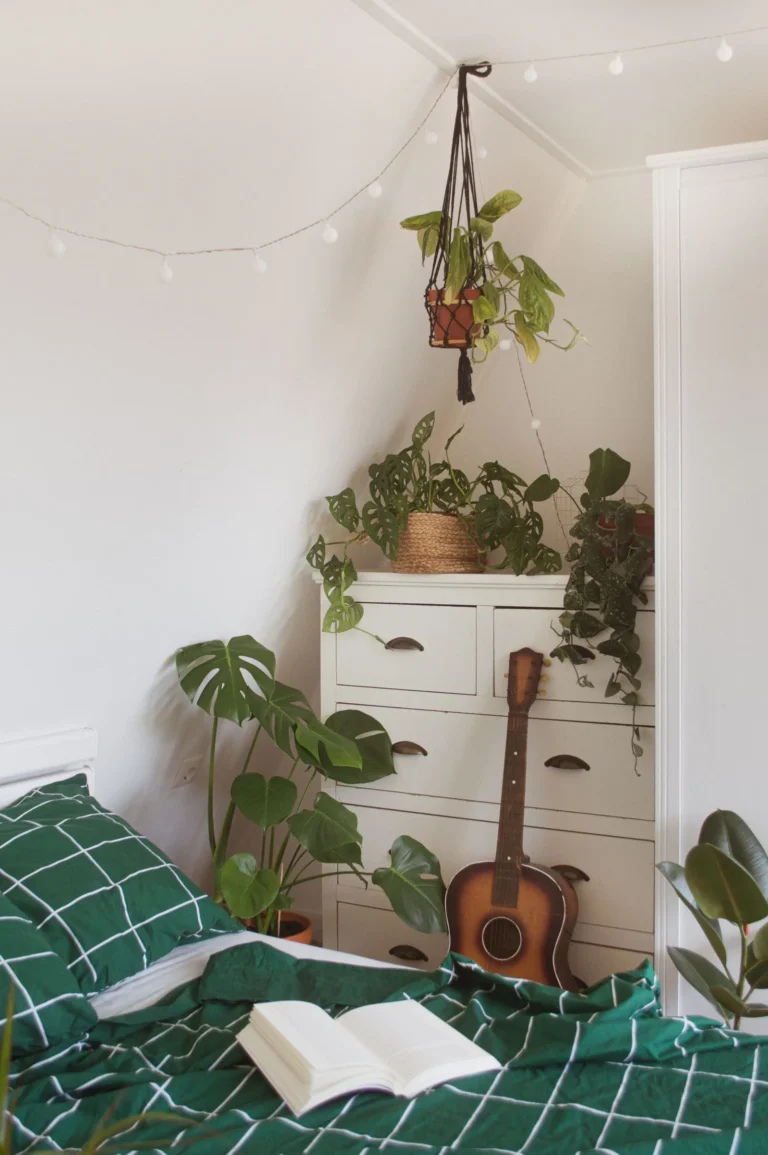
Small Bedroom Budget Makeover Ideas Under $100
Small bedroom budget makeover ideas under $100 start with one honest truth: most “under $100” makeovers quietly add up to nearer $200, because the small buys — a candle here, a frame there, a plant, a rug — are never counted. This one is counted. The money goes to the big surfaces first, the free jobs come before the spending, and the running total stops at $100. Here is the basket, item by item, and it is the whole makeover.
| What to buy or do | Cost | Running total |
|---|---|---|
| New bedding (duvet cover + pillowcases) | $40 | $40 |
| Warm light (2700K bulbs + one lampshade swap) | $25 | $65 |
| One throw + two cushions, one accent colour | $20 | $85 |
| One focal point (thrift mirror or rug) | $15 | $100 |
| Declutter + move the furniture (layout) | $0 | $100 |
| Total | $100 |
The ten ideas below follow that basket in order: the free jobs first, the bedding first among the buys, and the running total kept in sight the whole way. A small bedroom can change completely for under $100 — if the money goes where the eye goes, and nowhere else.

Credit: Pexels 376531, NastyaSensei
Key Takeaways
- Spend on the big surfaces first: bedding $40, light $25, cushions $20, one focal point $15 — and decluttering plus layout cost $0. Total: $100.
- Most “under $100” makeovers quietly total nearer $200 — this one stays under because every buy is counted in a running total that stops at $100.
- Do the free jobs first: declutter, then move the furniture — layout is free, and it changes the room before you spend anything.
- Warm light at 2700K is the cheapest lever in the room: swap the bulb, not the lamp.
Tip 1 — New bedding first: the bed is the room’s biggest surface
Buy new bedding first, because the bed is the room’s biggest surface — and the biggest surface is where the money shows. A fresh duvet cover and pillowcases, in one accent colour, change the whole room in the time it takes to make the bed, and no other single buy comes close. This is the $40 line in the basket, the biggest single spend, and it earns it: the bed is most of what you see when you walk in, so new bedding is a new room. Choose the colour once — dusty rose, soft blue, sage or clay — and the rest of the makeover follows it. Buy the duvet cover and the pillowcases as a set, and keep the sheets plain white, so the colour is one clean statement. A set from a budget shop or a sale is fine — the fabric matters less than the colour, and the colour is what the room sees. New bedding first, $40 spent, $60 left, and the room already looks different.

Credit: Pexels 7546564, Max Vakhtbovych
Tip 2 — One mirror from a thrift shop, cleaned and hung opposite the window
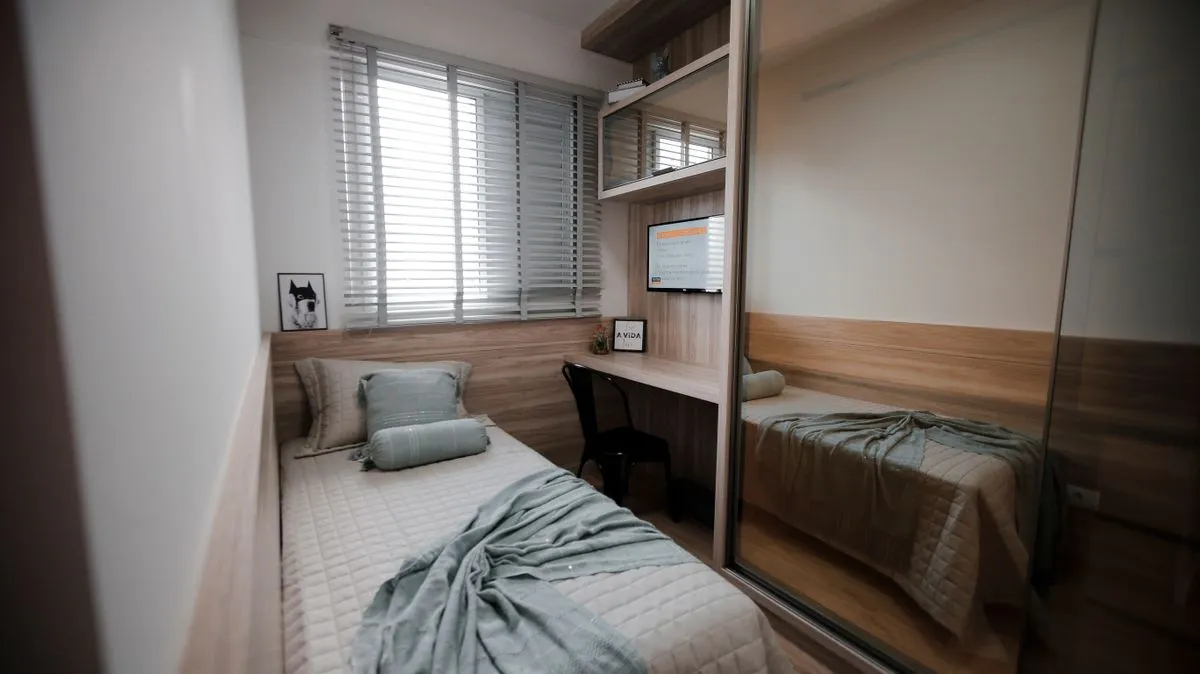
Buy one mirror from a thrift shop, clean it, and hang it opposite the window — because a mirror is the cheapest square footage a small bedroom can buy, and a thrift-shop mirror is the cheapest mirror there is. A large mirror in a charity shop or a second-hand listing costs a fraction of a new one, and once it is cleaned and hung on the wall facing the window, it doubles the daylight and makes the room feel bigger the same afternoon. This is the $15 focal point in the basket, shared with the rug in Tip 9 — spend it on the mirror or the rug, not both. Check the mirror before you pay: no cracks, no black spots at the edges, and a frame that is solid enough to hang. Clean it with a damp microfibre cloth, hang it at eye level, and check the angle in the morning — if you can see the window in it from the bed, the placement is right. One thrift mirror, $15, and the room gains a window it never had.
Credit: Pexels 11295825, Vidal Balielo Jr.
Tip 3 — Move the furniture before buying anything: layout is free
Move the furniture before buying anything, because layout is free — and a free change that works beats a bought change that does not. Turn the bed to face the window, move the nightstand to the other side, pull the wardrobe away from the door: each move costs nothing, and each one can change how the room feels more than any purchase. The running total stays at $0 while you try the new layout for a week, and only the moves that survive the week earn any spending at all. Try the obvious moves first: bed against the longest wall, headboard under the window only if the light suits it, and nothing blocking the door’s swing. Live with each layout for a few days before you decide — a layout that looks good in an empty room can feel wrong with a person in it. Move first, buy second, and the $100 goes to the room you actually live in.

Credit: Pexels 271695, Pixabay
Tip 4 — One throw and two cushions in a single accent colour
Buy one throw and two cushions in a single accent colour, because a set in one colour finishes the bed for $20. Two cushions in the bedding’s accent colour and one throw in the same family — folded at the foot of the bed — give the room its finished edge, and the set costs less than a single decorative object bought on its own. This is the $20 line in the basket, and it is the line that ties the bedding to the rest of the room: the colour repeats, the eye trusts it, and the bed looks dressed. Keep the count low — two cushions, one throw, no more — because a pile of cushions is clutter that has to be moved every night, and clutter is the opposite of a makeover. Buy the set in the same colour family as the new bedding, so the throw and cushions repeat the duvet cover rather than arguing with it. One throw, two cushions, $20, and the bed is dressed.

Credit: Pexels 11295765, Vidal Balielo Jr.
Tip 5 — A floating shelf as a nightstand costs $30–150 and frees the floor
Fit a floating shelf as a nightstand, and it frees the floor for the price of a shelf. A small floating shelf on the wall beside the bed holds the book, the glass of water and the lamp — everything a nightstand holds — and the floor underneath stays visible, which makes the room feel bigger. The price range is $30 to $150 depending on the shelf, and in this makeover the shelf is the budget stretch: if the thrift mirror and the rug are already bought, the shelf waits for the next $100. Fix the shelf at the height of the old nightstand, and check it with the lamp on it before you fix anything. A renter-friendly shelf on strong removable fixings comes down without a mark. One shelf, and the nightstand — and its footprint — is gone.

Credit: Pexels 7546720, Max Vakhtbovych
Tip 6 — Swap the lampshade, not the lamp
Swap the lampshade, not the lamp, because the shade is the part of the lamp you actually see — and a new shade is a fraction of the price of a new lamp. A plain lamp with a new shade in your accent colour, or a shade in a warm linen that softens the light, changes the whole corner for the cost of the shade alone. This is part of the $25 light line in the basket, shared with the warm 2700K bulbs: swap the bulb for a warm one, swap the shade for one that suits the room, and the evening light is new. Choose a shade that throws the light forward and down, not up at the ceiling, and check it in the evening before you commit — a shade that looks right in the shop can look dark at home. One shade, one warm bulb, and the cheapest lever in the room has been pulled.

Credit: Pexels 6758519, Max Vakhtbovych
Tip 7 — Declutter first: a free makeover that makes every purchase look better
Declutter first, because it is a free makeover that makes every purchase look better. A room full of clutter swallows new bedding, a new mirror and new cushions — the buys disappear into the mess, and the $100 is wasted. A room that has been decluttered, on the other hand, shows every purchase: the bedding is the bed, the mirror is the wall, the cushions are the colour. The declutter costs $0 — it is the free line in the basket — and it is the job that makes the other lines worth spending. Run the one-in-one-out rule as you declutter: nothing new enters without something leaving, and the maybe box takes anything you cannot decide about, with a 30-day deadline. Clear the surfaces to three items each, and the room is ready for its new things. Declutter first, $0 spent, and every dollar after it shows.

Credit: Pexels 16648032, LỬNG Studio
Tip 8 — Paint one rectangle behind the bed, not the whole room
Paint one rectangle behind the bed, not the whole room, because one rectangle is a headboard made of paint — and a small tin of paint is the cheapest colour a room can buy. A rectangle the width of the bed and the height of a headboard, in a deep sage, a dusty rose or a soft clay, frames the bed and gives the room its focus, while the rest of the walls stay light and the room stays bright. The paint comes out of the $15 focal-point line only if the mirror and the rug have not already spent it — otherwise the rectangle waits, or the fabric version takes its place. If you rent, the same rectangle works in fabric: a large piece of cloth on a tension rod or removable hooks gives the same block of colour with no paint at all. Keep the edges crisp with painter’s tape, and the rectangle reads as a deliberate design, not a patch. One rectangle, one colour, and the bed has a headboard for the price of a small tin.

Credit: Pexels 11295816, Vidal Balielo Jr.
Tip 9 — Thrift the rug, wash it, layer it under the bed
Thrift the rug, wash it, and layer it under the bed — because a second-hand rug, washed and laid properly, is the cheapest warmth a cold floor can get. Charity shops and second-hand listings are full of rugs that are barely worn, and a washable one goes in the machine and comes out fresh, ready to slide under the front legs of the bed. The rug shares the $15 focal-point line with the mirror: spend it on one or the other, not both, and the total still stops at $100. Check the rug before you pay: no stains that will not wash out, no smell that survives a wash, and a size that fits — about 5 by 7 feet, or two small rugs, one each side of the bed. Wash it before it goes on the floor, and the thrift rug is as clean as a new one. One thrift rug, washed, layered, and the floor is warm.

Credit: Pexels 34053470, Fernanda Neitzel
Tip 10 — Keep a running total, stop at $100, and photograph before and after
Keep a running total, stop at $100, and photograph before and after — because the total is the only thing that keeps a budget makeover honest. Write each buy down as you make it: bedding $40, light $25, cushions $20, focal point $15, declutter and layout $0 — and when the total hits $100, stop. No candle, no frame, no extra cushion, however small, because the small buys are exactly how “under $100” quietly becomes nearer $200. Photograph the room before you start, from the doorway, and photograph it again from the same spot when the total hits $100. The two photos side by side show what the money did — and what it did not need to do. A running total, a hard stop at $100, and the makeover is done, honestly.

Credit: Pexels 31846736, Vadim Malitskii
FAQ
Can you really make over a small bedroom for under $100?
Yes — if the money goes to the big surfaces first and every buy is counted. This makeover totals exactly $100: bedding $40, warm light $25, one throw and two cushions $20, one focal point $15, and decluttering plus moving the furniture for $0. The free jobs come first, and the total stops at $100.
Why do most “under $100” makeovers cost more?
Because the small buys are never counted — a candle here, a frame there, a plant, a rug — and they quietly add up to nearer $200. The fix is a written running total: write each buy down as you make it, and stop when the total hits $100, no matter how small the next buy looks.
What should I spend the most on in a budget bedroom makeover?
The bedding. The bed is the room’s biggest surface, so a fresh duvet cover and pillowcases in one accent colour change the whole room — $40 of the $100 goes there, and it is the single buy that shows the most.
What is the cheapest way to make a small bedroom feel warmer?
Warm light at 2700K: swap the bulb, not the lamp, and swap the lampshade if the old one is tired. Warm light is the cheapest lever in the room — one bulb and one shade, $25 in this basket, and the evening feels like a different room.
Should I buy a mirror or a rug first on a $100 budget?
One or the other, not both — they share the $15 focal-point line in this basket. Choose the mirror if the room is dark, because it doubles the daylight; choose the rug if the floor is cold, because it warms the first step of the morning. Thrift either one, and $15 is enough.
Is a budget bedroom makeover renter-friendly?
Yes — every idea here needs no paint on the whole wall and no drilling: a leaning mirror, a fabric rectangle instead of a painted one, a floating shelf on removable fixings, and a layout move that costs nothing. The colour lives in textiles, and it all moves with you.
Final Thoughts
Small bedroom budget makeover ideas under $100 work when the money goes to the big surfaces first and the total is counted honestly: new bedding for $40, warm 2700K light for $25, one throw and two cushions for $20, one thrift mirror or rug for $15, and decluttering plus a new layout for $0 — a running total of exactly $100, with a hard stop when it gets there. Most “under $100” makeovers quietly total nearer $200, because the small buys are never counted; this one counts them. Move the furniture before buying anything, declutter first so every purchase shows, swap the lampshade instead of the lamp, and photograph the room before and after from the same spot. A small bedroom can change completely for $100 — if the $100 is spent where the eye goes, and nowhere else.
Save this post on Pinterest for your next budget refresh, and read our earlier budget and colour ideas next: Small Bedroom Mirror Ideas That Make It Feel Bigger; Small Bedroom Colour Ideas Without Painting Walls; Small Bedroom Bedding Ideas For A Cozy Night In; Small Bedroom Colour Ideas That Make It Feel Bigger; and Budget Cozy Corner Ideas For Small Rooms.
More inspiration: Throws; Lighting.
Written from small-room living experience — every idea here is practical for a tiny bedroom, with a no-drill option wherever drilling is a problem.
Last updated 18 Nov 2026.
Refresh in 3–6 months: re-check the thrift finds and the running total against current prices, and photograph the room again.