Small Closet Storage Ideas That Double Your Space
Small closet storage ideas that double your space start with one simple truth: a small closet is almost never full — it is badly used. Most closets have one rail and one shelf, with empty air above the shelf and below the hems, and a rail crammed with hangers of five different shapes. Use the height, make the hangers match, and keep only this season’s clothes inside, and the same small closet holds roughly twice as much — without a single new piece of furniture.
The ideas below work in that order: add a second rail first, slim the hangers second, and only then buy baskets and boxes for what is left. The closet does not get bigger; it just stops wasting its own space.
Last updated 14 Nov 2026. Refresh in 3–6 months: re-check the rails for sagging, and swap the seasonal box when the weather turns.

Key Takeaways
- A second hanging rail is the single highest-return change — it roughly doubles hanging space for anything short, like shirts, skirts and folded trousers.
- Slim matching hangers recover several centimetres of rail across a full closet, and keep the shoulder line even so the rail reads as tidy.
- Only one season lives in the closet — off-season clothes go in a labelled box under the bed or on the top shelf.
- One in, one out: when something new comes in, something old goes out, or the closet fills up again within a month.
Double hanging rails, two levels
A second rail under the first is the single best change you can make to a small closet. Most closets have one rail at the top and a long drop of empty air below it, where shirts hang and the space underneath them goes to waste. Add a lower rail and that dead air becomes a second row of hanging space — shirts and skirts up top, folded trousers and shorter tops below — and the hanging capacity roughly doubles overnight. The photo shows exactly that: a walk-in closet with clothes hanging on two levels, an upper rail and a lower rail, plus drawers below.
Mount the lower rail about a metre below the upper one, so shirts and skirts hang freely without touching the shelf or the floor below, and keep long dresses and coats on the upper rail at one end where they have the full drop.

Slim matching hangers
A rail fills up faster than it should because the hangers are bulky and mixed — chunky plastic next to wire next to wood, each one a different width, each one taking more space than the clothes on it. Slim matching hangers fix that in one swap: thin velvet or slim wooden hangers take far less width than chunky plastic ones, and because they are all the same, the clothes hang at the same height and the rail reads as one tidy row instead of a jumble. The photo shows the result: clothes hanging in a neat row on matching light wooden hangers on one rail.
Swap the hangers in one go rather than a few at a time — a rail that is half slim and half chunky still looks crowded, and you will not see the space you have gained.

Shelf dividers for folded stacks
Folded stacks are the closet’s quiet failure: a neat pile of T-shirts slowly leans, slides and collapses into the pile next to it, until the whole shelf is one long jumble. Shelf dividers stop that — simple upright panels that stand on the shelf and hold each stack in its own lane, so a stack of jumpers stays a stack of jumpers and never leans into the jeans. The photo shows the stacks themselves rather than the dividers: neatly folded T-shirts stacked in rows inside a drawer, each row holding its shape because it has a boundary.
Use one divider per stack and keep the stacks low — five or six items, not twelve — so nothing topples when you pull the one at the bottom. Knits, T-shirts and jeans fold best; anything that wrinkles belongs on a hanger instead.

Over-door hooks/organiser
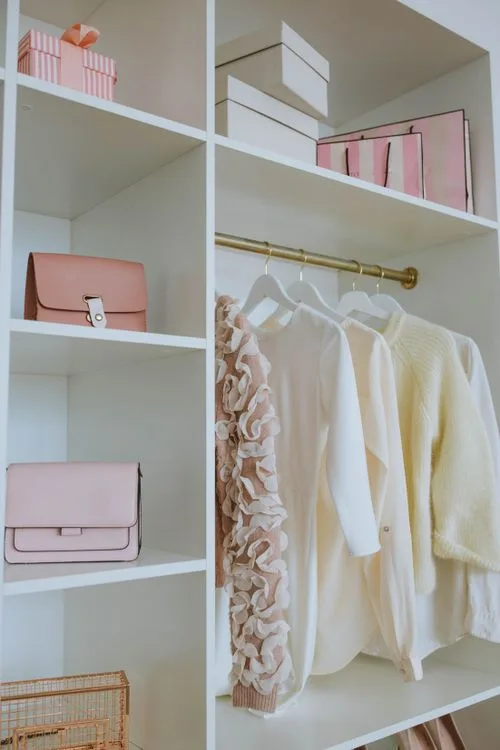
The back of the closet door is the most underused surface in a small bedroom — a whole flat panel of space that usually holds nothing at all. An over-door organiser turns it into storage: a hanging pocket organiser for scarves, socks and small things, or a hook rail for bags, belts and tomorrow’s outfit. The photo shows the organised wardrobe interior that an over-door organiser helps you keep — white wardrobe shelves with pink handbags, gift boxes and clothes hanging on a brass rail, everything with a home instead of a pile on the floor.
Choose an organiser that hangs over the top of the door, not one that screws in, so it leaves no marks and moves with you. Keep it to light things — scarves, belts, small bags — because a heavy organiser pulls the door out of line and stops it closing.
Labelled baskets on the top shelf
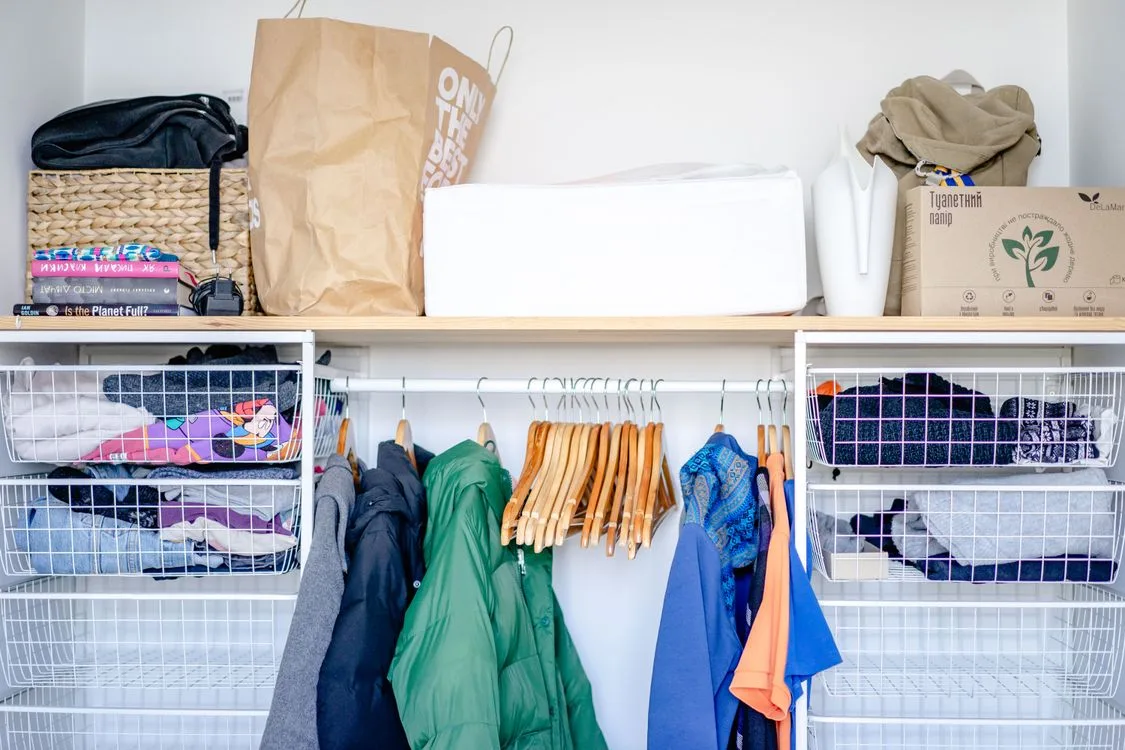
The top shelf is the closet’s attic: high, hard to reach, and the first place things go to be forgotten. Labelled baskets fix that — one basket per category, with a label on the front you can read from the floor, so the top shelf becomes a filing system instead of a dumping ground. The photo shows the baskets in place: an open wardrobe with wire storage baskets full of folded clothes, a woven basket and storage boxes on the top shelf, each one holding a category.
Label the baskets even when you think you will remember what is inside, because you will not — not in three months, when the seasons have changed and you are reaching up blind.
Shoe rack at the closet floor
Shoes on the closet floor are the first thing to go wrong: pairs separate, heels scuff, and the floor disappears under a drift of footwear until you cannot see the carpet at all. A low shoe rack at the closet floor gives every pair a slot — one pair per space, visible at a glance, and off the floor so the closet reads as tidy the moment you open the door. The photo shows the same idea on low wardrobe shelves instead of a floor rack: an oak wardrobe with dresses hanging above and heels stored on low shelves, each pair together and easy to reach.
Keep the rack to the shoes you actually wear this season — two or three pairs, not ten — and store the rest elsewhere. A rack that holds six pairs and holds six pairs is a system; a rack that holds six pairs and has twelve more piled beside it is just a decoration.

A small drawer unit inside the closet
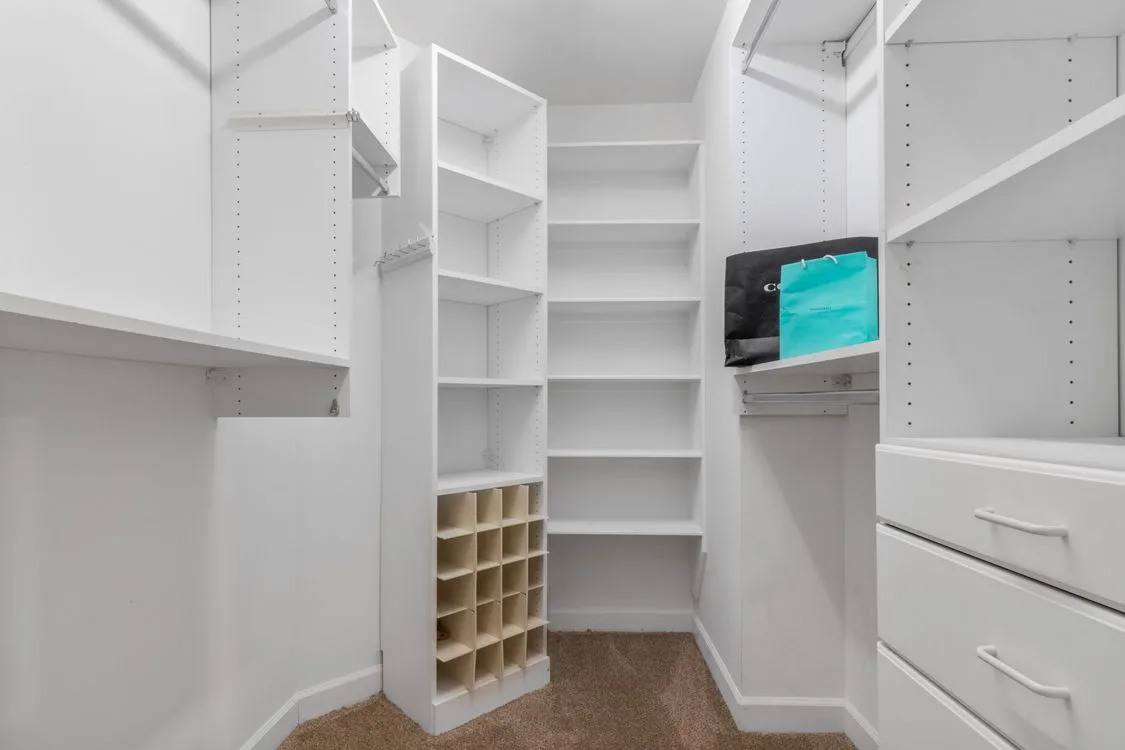
A small set of drawers inside the closet is the missing piece most small wardrobes never get: somewhere for the small things — socks, underwear, belts, jewellery — that have no business on a hanger and no business in a pile on a shelf. Slide a slim drawer unit onto the closet floor, under the hems of the hanging clothes, and the small things finally have a home. The photo shows the built-in version of the same idea: a spacious white closet interior with shelves and a bank of drawers built in, the drawers doing the quiet work underneath the hanging space.
Measure the floor space before you buy — the unit must fit under the hanging clothes without the hems catching on it, and you must still be able to open the drawers fully.
Scarves and belts on one rail hook set
Scarves and belts are the closet’s escape artists: they slide off hangers, fall behind the rail, and end up in a tangled knot at the bottom of the wardrobe. One rail hook set — a single hook with several rings, or a small rail of hooks hung from the main rail — gives them one home: every scarf on its own ring, every belt on its own hook, all visible and all untangled. The photo shows the delicate things that need that home: delicate clothes and a sheer pink scarf-like fabric hanging beside shelves of beige heels, the scarf kept separate and visible instead of lost in a drawer.
One hook set, one category, and the small accessories stop disappearing.

One-in-one-out rule for clothes
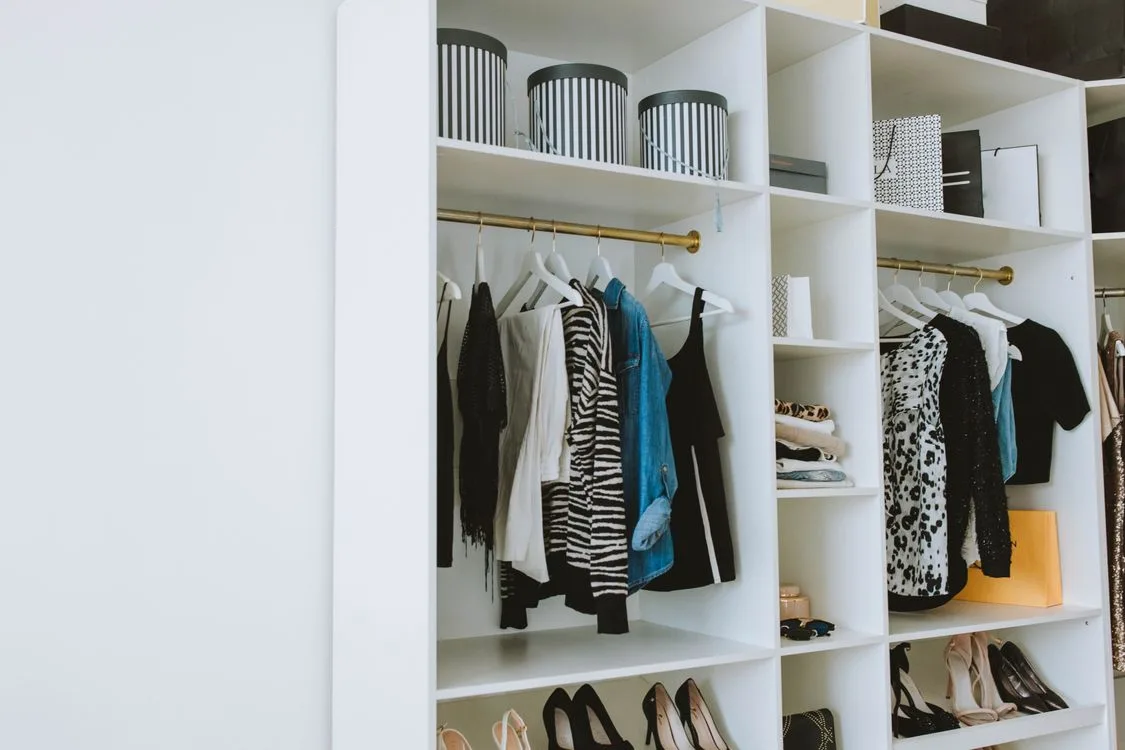
No closet system survives a closet that keeps growing. The one-in-one-out rule is the guardrail: when something new comes in — a jumper, a pair of jeans, a dress — something old goes out, to the charity shop, to a friend, or to the recycling. The closet stays the same size, the rail stays readable, and the system you built in the first eight tips keeps working instead of slowly drowning. The photo shows the result of the rule kept: a tidy white wardrobe with clothes on brass rails, folded stacks on shelves and heels below, nothing overcrowded and everything visible.
Make the rule easy to keep by keeping a donation bag in the closet itself — when something comes out, it goes straight in the bag, and when the bag is full it goes to the charity shop.
Seasonal swap box, rotate twice a year
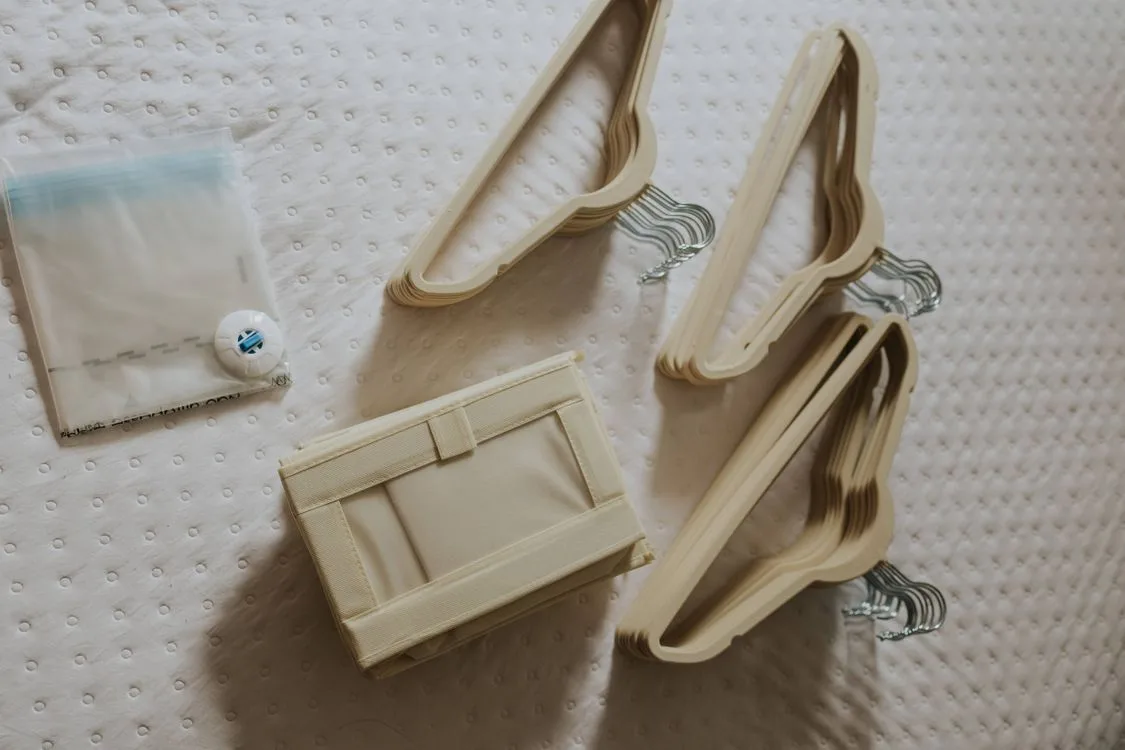
A small closet cannot hold a full year of clothing and stay usable — it can hold one season well, and two seasons badly. Pack the season you are not wearing into a labelled swap box and move it out: under the bed, on top of the wardrobe, or in a suitcase you rarely use. The photo shows the swap box itself: a flat lay of beige wooden hangers and a fabric storage box with a vacuum-seal bag on a quilted surface, the off-season packed away and ready to store.
Swap the boxes twice a year, when the weather turns, and treat the swap as a cleanout — anything you did not miss while it was in the box can go.
How do I double the space in a small closet?
Add a second hanging rail under the first for short pieces, switch to slim matching hangers, and move the off-season out into a labelled box. Together those three changes usually add more capacity than any container will, and none of them needs a renovation.
What is the best way to organise a small closet?
Edit first, then build up: take out what you do not wear, add a second rail and an extra shelf, use the door for an organiser, and put only this season’s clothes on the rail. Fold knits and jeans, hang only what wrinkles.
Should I fold or hang clothes in a small closet?
Fold knits, T-shirts and jeans on shelves or in a hanging organiser, and hang only what wrinkles — shirts, dresses, jackets. Folding saves rail space, and rolled T-shirts take up even less. Keep folded stacks low and divided so they do not topple.
How do I use the top shelf of a closet?
With labelled baskets, one per category, labels facing out so you can read them from the floor. Keep the top shelf for things you reach for rarely — off-season clothes, occasion wear, spare bedding — and keep the heaviest basket at the front.
Where do I put clothes if my closet is too small?
Store off-season clothes in lidded boxes under the bed, on top of the wardrobe, or in a suitcase you rarely use. Only this season’s clothes need to be in the closet, and a suitcase that sits empty most of the year is storage you already own.
How do I stop my closet filling up again?
One in, one out: when something new comes in, something old goes out. Keep a donation bag inside the closet so the outgoing item leaves the same day, and do a seasonal swap twice a year to catch anything you stopped wearing.
Final Thoughts
Small closet storage ideas that double your space work when the height gets used and the closet holds only this season: a second rail for short pieces, slim matching hangers, dividers for folded stacks, an organiser on the door, and labelled baskets on the top shelf. Shoes get a rack on the floor, small things get a drawer unit, scarves and belts get one hook set, and the one-in-one-out rule keeps it all from filling up again. The closet does not get bigger — it just stops wasting the space it already has.
Save this post on Pinterest for your next wardrobe refresh, and read our earlier closet and bedroom ideas next: Small Bedroom Colour Ideas That Make It Feel Bigger, Small Space Shoe Storage Ideas That Work Well, Budget Small Space Storage Ideas That Save Money, and Small Space Storage Ideas That Use Every Wall.
Written from small-room living experience — every idea here is renter-friendly and needs no renovation.
Further reading: HGTV’s 25 ways to organize a small closet and IKEA’s guide to organizing the inside of your wardrobe in 5 easy steps show more rail, hanger, and basket ideas for the same small space.
Frequently Asked Questions
How far apart should double hanging rails be in a small closet?
Mount the lower rail about a metre below the upper one, so shirts and skirts hang freely without touching the floor. Leave clearance for hangers to slide, and measure your longest item before fixing the rail. If the rails are too close, hems bunch and wrinkle, and the second rail saves no space.
Do slim matching hangers really save space in a small closet?
Yes. Slim hangers are thinner than chunky plastic or wooden ones, so a full rail gains several centimetres, and matching hangers stop clothes sliding to one side. Swap them in one go, because a half-slim rail still looks crowded and wastes the gain. Keep the same style throughout, so shoulders stay neat and items hang evenly.
How do shelf dividers keep folded clothes tidy?
Dividers stop tall stacks leaning, sliding, and collapsing when you pull one item out. Use one divider per stack, keep stacks to five or six items, and fold each piece to the same width. That way every stack stays upright, you can see what is there, and putting laundry away takes seconds.
What should I store on the back of the closet door?
Use over-door hooks or a hanging organiser for scarves, belts, bags, and other light accessories that otherwise slide off hangers or vanish behind the rail. Choose a model that hangs over the top of the door, so it leaves no screw marks and suits a rented home. Keep one hook set per category, so everything stays visible.
How many pairs of shoes should I keep in a small closet?
Keep only the two or three pairs you wear this season on the closet floor, on a low rack where each pair has its own place. Store the rest in labelled boxes under the bed or on top of the wardrobe, and rotate them with the season. That stops pairs separating, heels scuffing, and the floor filling up again.